HeyImmo
ImmoScout24 • Real Estate AI Assistant
Product ImmoScout24’s AI assistant for real estate questions, contextual guidance and conversational property search
Impact Launched within a ~19 million-user platform and later highlighted by Scout24’s CEO as a key part of the company’s AI strategy
My Role Lead UX/UI designer during delivery, translating a defined product vision into a coherent cross-platform experience
Platform Web, iOS and Android
Timeline Feb 2025 to Oct 2025
Context & Contribution
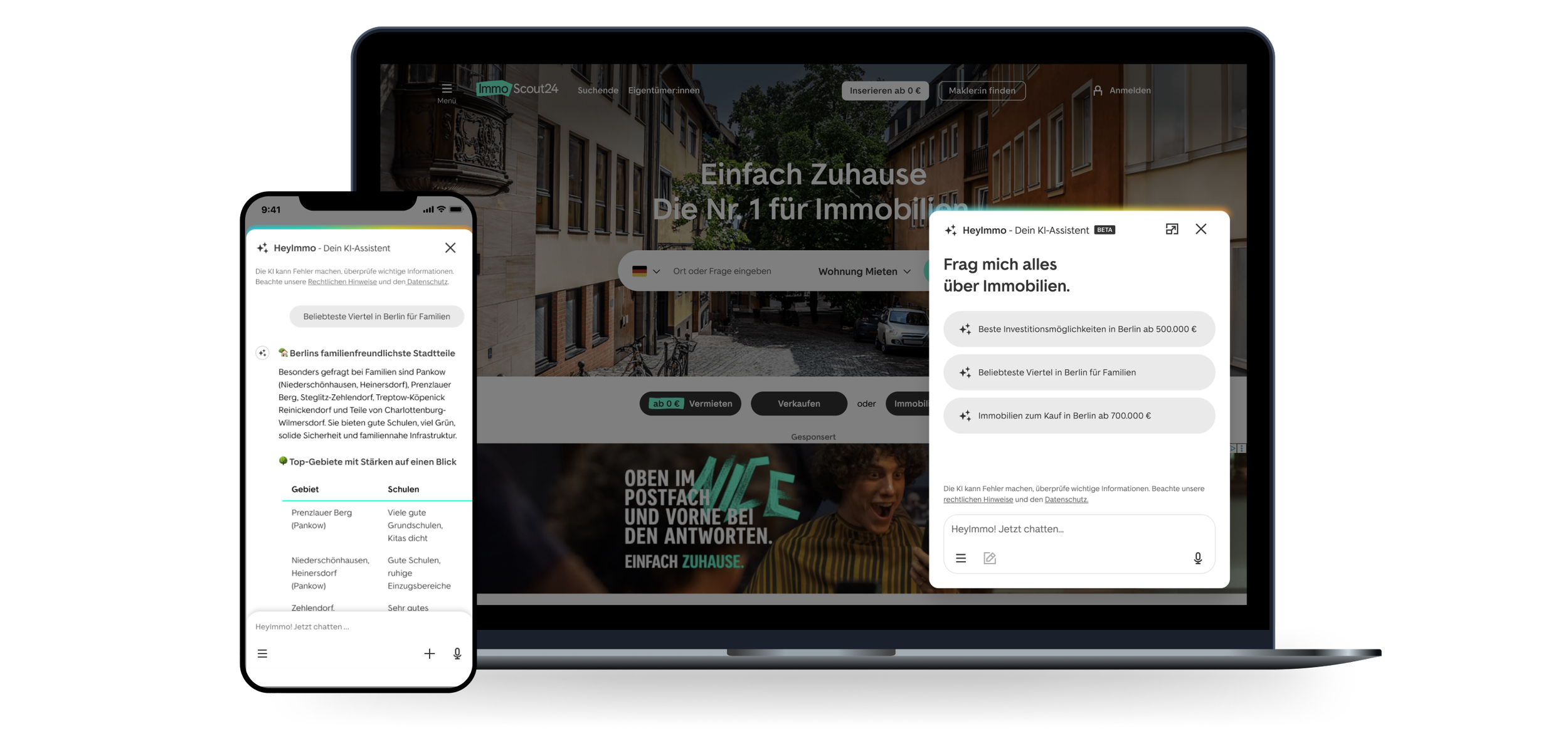
Real estate journeys involve more than finding a listing. Users face open questions around costs, locations, documents, applications and next steps. HeyImmo brings this guidance into ImmoScout24, helping users get contextual answers and discover relevant properties or services in one place. I joined after the initial explorations and led the UX/UI delivery towards launch across web, iOS and Android, while also giving early feedback on tone and response quality.
Making answers trustworthy & actionable
A core challenge was making HeyImmo feel like more than a generic chat interface. Working closely with Product and inspired by leading AI assistants, I shaped patterns that made the experience more trustworthy, actionable and connected to ImmoScout24’s ecosystem.
This included prompt suggestions to clarify what users could ask, product linkouts to connect advice with relevant ImmoScout24 offerings, sources to support credibility, and feedback options to help improve response quality over time.
Making complex questions easier to ask
Real estate questions can be long and situational, especially on mobile. Voice input gave users a faster way to ask complex questions without typing or structuring them perfectly. Using familiar messaging and AI patterns, the interaction stayed simple: tap the mic, ask a question and continue the conversation.
Designing for perceived performance
Response times from HeyImmo ranged between 15–30 seconds, especially when a web search was required. While the tech team worked to reduce load times to the 3–10 second standard, we also needed a UX solution to improve perceived performance.
We addressed this through three measures:
Transparency: Displaying what HeyImmo is doing, e.g. “Checking further sources” or “Looking for properties.”
Paraphrasing: Showing an initial, rephrased summary of the user’s input to create instant engagement.
Delight: Adding a colorful spinner to make waiting feel lighter and more dynamic.
Designing history as a reason to sign in
As HeyImmo was a free tool, we wanted to use its value to encourage sign-in and deeper platform engagement. Real estate questions often unfold over time, so users needed a way to return to previous advice, continue conversations or start fresh.
I worked on the history, new chat and logged-out states to make conversation management clear and lightweight, while explaining the benefit of saving chats without making sign-in feel like a hard interruption.
Impact of HeyImmo
HeyImmo launched in October 2025 as a free AI assistant across ImmoScout24’s app and website, within a platform of around 19 million monthly users. As a high-visibility initiative with management involvement, it became part of Scout24’s broader AI strategy and supported the shift towards more conversational real estate experiences.
My work helped turn the assistant into a launch-ready cross-platform product experience, with patterns for trust, actionability, perceived performance, voice input and conversation history.
Takeaways
Keep key acceptance criteria close to the design
When developers start implementation from empty or unrefined tickets, important details will get lost. Adding relevant acceptance criteria directly next to the Figma designs would ensure that key interactions, states, animations and edge cases are still considered, even when the ideal refinement process cannot be followed due to time pressure.
Use a shared QA backlog
Instead of adding every UX/UI finding in a separate tickets, a FigJam improvement backlog made Design QA faster and easier to discuss. It helped collect issues in one place, group related findings and decide with the team what needed action.